Your Pension Is Probably Invested in the Wrong Thing. Here Is How to Check
Let us tell you what we did for years. Every month, money left our payslips and went into a pension. We knew it was happening. We had a vague sense it was a good thing. And we never once logged in to look at what it was actually doing.
We are not embarrassed to admit that because we think most people are in exactly the same position. The pension is this abstract thing that exists somewhere in the background. You cannot touch it, you cannot spend it, so you do not think about it. You just trust that someone somewhere is looking after it sensibly.
When we finally logged in, what we found was not a disaster. But it was not good either. The default fund we had been put in had charges that were higher than they needed to be, an asset allocation that was more cautious than made any sense for our age, and a target retirement date that nobody had ever asked us about.
Fixing it took about an hour. The difference that hour will make to our retirement pot over the long term is not small. That is why we are writing this.
Most people in the UK never check how their pension is invested. And that is where the problem starts.
Why the default is almost never right for you
When you join a workplace pension scheme, you are automatically put into a default fund. Your employer chose the pension provider. The provider set a default. Nobody asked what you wanted, what age you plan to retire, or how much risk you are comfortable with.
The default is designed to be acceptable for the average employee. Not optimal for you. Not the cheapest available. Not tailored to your timeline. Just broadly inoffensive for the widest possible group of people.
The most common default in UK workplace pensions is a lifestyle or target date fund. These start by investing in higher-growth assets when you are young and gradually shift toward bonds and cash as you approach a set retirement age. The logic is fine in theory. In practice, the execution is often off in ways that cost you money.
The default retirement age is frequently set at 65 regardless of when you actually want to stop working. The shift toward safer assets often starts earlier than it needs to, cutting off years of growth while you still have decades of compounding ahead of you. And the ongoing charge is sometimes significantly higher than comparable passive funds you could switch into.
What we found when we actually looked
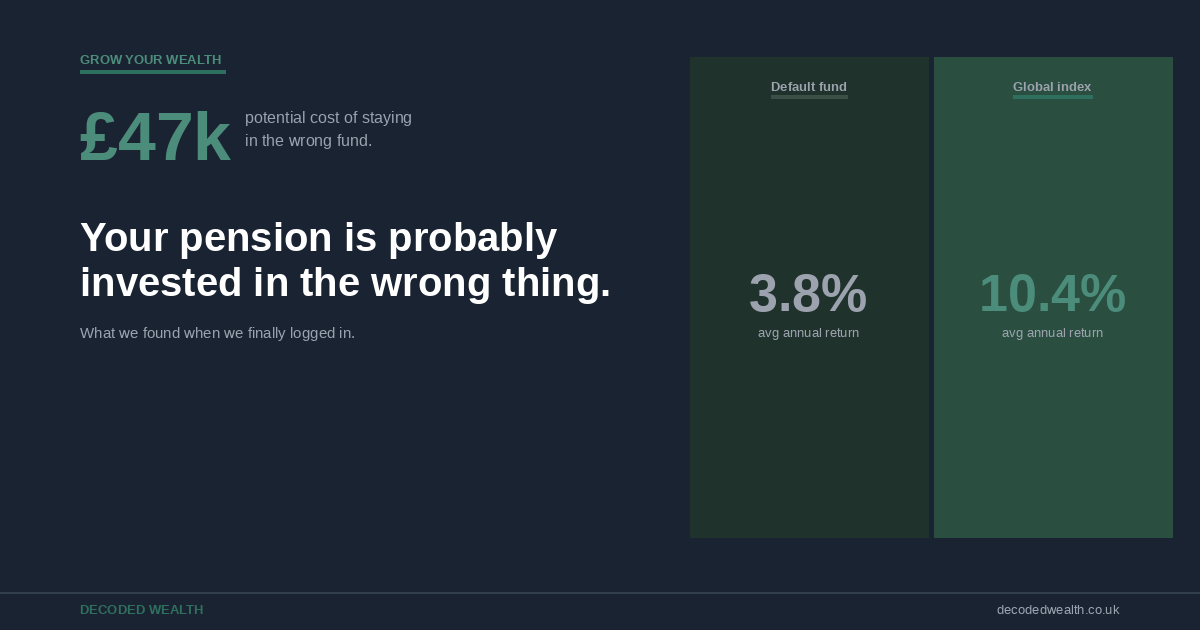
Our default fund was charging just over 0.75 percent a year. That sounds small. On a 50,000 pound pot, that is 375 pounds a year in fees. On a 200,000 pound pot it is 1,500 pounds a year. Every year. For decades. Compared to a passive global equity fund at 0.2 percent inside the same scheme, that difference compounds into tens of thousands of pounds by retirement.
The asset allocation was also more conservative than it needed to be for our age. A meaningful chunk was already sitting in bonds and cash, assets that grow slowly and are designed to protect rather than grow wealth. At decades away from retirement, that is exactly the wrong balance. You have time to ride out market volatility. What you need is growth.
Neither of these things was obvious from the outside. We had to log in, find the fund factsheet, read the small print, and compare it against other options inside the same scheme. It took an evening. It will be worth thousands.
How to find out what yours is doing
Log into your pension provider’s online portal. If you do not know who your provider is, check with your HR or payroll team. Most major UK providers have apps and online dashboards and the information you need should be accessible within minutes.
Find your fund name: It will usually say something like Default Lifestyle Strategy or have a target year in the name. Write it down, then look it up. The provider’s website will have a fund factsheet.
Check the ongoing charges figure: This is the annual cost of the fund, expressed as a percentage. It will be listed as an OCF or AMC. Anything above 0.75 percent deserves scrutiny. Many solid passive pension funds charge 0.2 to 0.4 percent. The difference matters enormously over decades.
Look at the asset allocation: The factsheet will show what percentage is in equities, bonds, property, and cash. If you are in your 30s or 40s and your fund already holds a large proportion in bonds and cash, it is likely being too cautious and costing you growth at exactly the stage when time is on your side.
Check your nominated retirement age: This is the date the scheme is planning around for when it starts shifting your money toward lower-risk assets. If it says 65 and you want to retire at 58 or 60, the de-risking happens at completely the wrong time. Change it.
You can check your State Pension forecast in a few minutes here.
The retirement age question nobody asks you
This is the one that surprised us most. Your pension scheme has a target retirement age baked in, usually 65, and it affects how your money is invested right now. If you plan to retire earlier or later than that, your current allocation may be working against your actual plans.
The earlier you want to retire, the sooner you will need to start drawing on your pension. That means you may want to de-risk earlier than someone planning to work until 67. But it also means you need a larger pot to fund more years of retirement, which means you need stronger growth earlier on. The two things are in tension and you need to think about both.
If you have not thought about when you want to retire, even roughly, now is a good time to start. It does not need to be precise. But knowing whether your answer is closer to 55 or 70 changes the entire strategy.
If you want to see how this affects your numbers, you can use the free calculator here.
What good looks like at different stages
30 or more years to retirement: High equity exposure makes sense here. A fund that is 80 to 100 percent in global stocks is not reckless at this distance. It is appropriate. You have time to recover from any dips. What matters is growth, and equities have historically delivered it over long periods.
15 to 30 years to retirement: Still mostly equities, but with more thought about diversification across regions. Charges really matter here. Every extra 0.5 percent in annual fees over 20 years is a material reduction in your final pot.
Under 15 years to retirement: This is when gradually reducing risk starts to make genuine sense. Moving some proportion toward bonds protects against a serious market fall in the years just before you need the money. But even here, going too conservative too early leaves growth on the table.
What you can do right now
If you look at your pension and decide the default does not suit you, you almost certainly have options. Most workplace pension providers allow you to switch funds within the same scheme at no cost and with no tax consequences.
The first thing to look for is whether your scheme has a global equity index fund as an alternative to the default. These are usually cheaper, passively managed, and have historically performed well over long time periods. You are not picking stocks. You are buying the world.
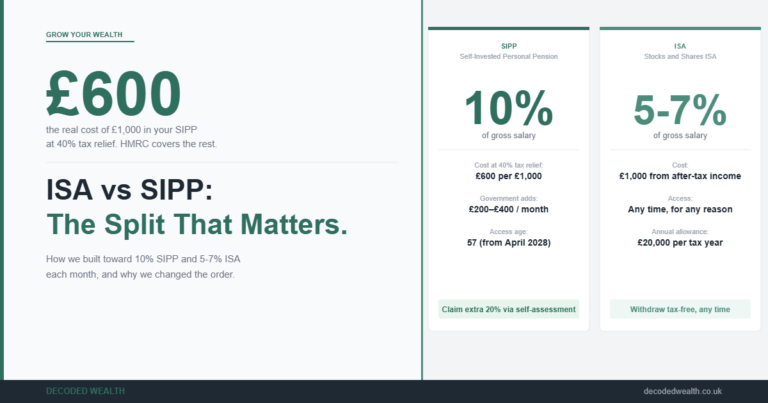
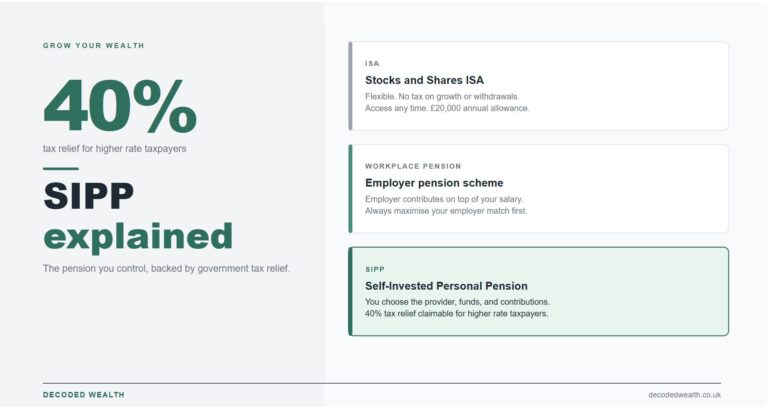
If your workplace scheme has limited options or high charges across all funds, you can also open a personal pension called a SIPP alongside your workplace pension for additional contributions. But always use the workplace pension first, at minimum enough to get your full employer match. That is free money and nothing comes close to it as a return.
One hour. Genuinely.
Your pension is almost certainly going to be the largest financial asset you ever own. For most people in the UK, the pension pot ends up worth more than their home. And most people spend more time deciding what to watch on a Friday night than they have ever spent looking at how that money is invested.
We are not saying become an expert. We are saying spend one evening logging in, reading the factsheet, checking the charges, and seeing if there is a better option available inside your existing scheme. That is it. One evening, done once, with a potentially significant impact on where you end up.
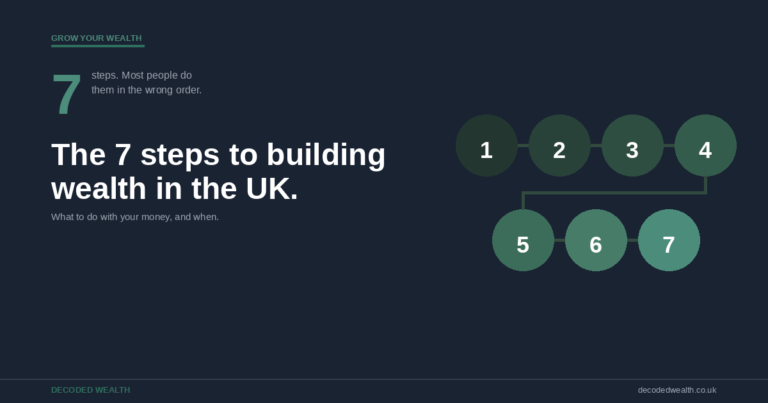
If you want to understand how your pension fits into the broader picture of building wealth, see the full 7-step wealth-building order here, it covers the full sequence including when to prioritise your pension above everything else.
Capital at risk. Investments can go down as well as up. This article is for informational purposes only and does not constitute financial advice. Decoded Wealth is not regulated by the FCA. Always do your own research before making financial decisions. This article may contain affiliate links. If you use them, we may earn a small commission at no extra cost to you.