How to Make More Money in the UK (Without a Pay Rise)
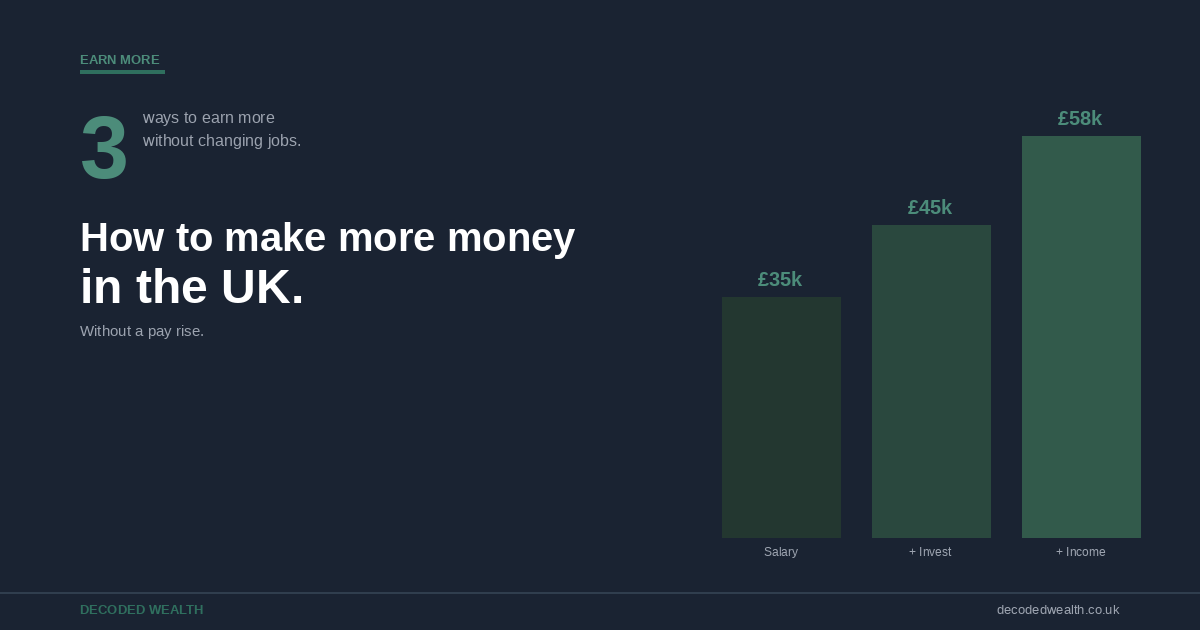
Most people treat their salary like the only number that matters.
For years, so did we.
You work, you get paid, you spend, you repeat.
The idea that money could come from somewhere else feels like something that happens to other people.
But once we started actually looking at how wealth gets built, the picture changed completely. A salary is not wealth. A salary is income. And income from one source is fragile.
The goal is not to replace your salary overnight. It’s to reduce your dependence on it over time.
This article is about shifting how you think about money coming in. Not as a fantasy about quitting your job, but as a practical way to make your financial life more stable and more rewarding over time.
If you’re still working on structuring your money properly, this is where we’d start : our multi account budget system
Why your salary alone is not enough in the UK
Your salary comes with a hard limit. There are only so many hours in a week, and at some point you hit a ceiling, whether that is because of the industry you are in, the role you have, or just the reality of not wanting to work every waking hour.
On top of that, a salary is tied to one decision: whether your employer keeps you on. Redundancies happen. Companies restructure. Industries change. Relying entirely on one income source means one decision made by someone else can unravel your whole financial situation.
We are not saying panic about this. We are saying it is worth building something alongside it, even slowly, even in small amounts.
The four types of income worth knowing about
When we started learning about this properly, we came across a simple breakdown that stuck with us. Income basically falls into four categories.
Earned income is what you get from your job or self-employment. Trading your time for money. Most people live entirely here.
Investment income is money your money makes. Dividends from shares, interest from savings, returns from an ISA. You put money in, it grows, it sometimes pays you along the way. In the UK, the stocks and shares ISA is your best friend here, start here: how to use your ISA allowance properly
Rental income is money from property. You own something, someone pays to use it. This is a big one in the UK, though it requires serious capital to start and comes with its own headaches.
Business or passive income is money that flows from something you built. A blog, a digital product, a side hustle that no longer needs you there every hour. This takes time to build but can eventually run with minimal input.
Most people start with earned income and over time try to build some investment income alongside it. That is not a bad plan at all.
Investing: making your money work over time
This is the one most UK adults have access to right now, regardless of salary. You do not need to be wealthy to start investing. You need a stocks and shares ISA and a small amount of money you can leave alone.
The basic idea is this: when you invest in a broad index fund, you are buying a tiny slice of hundreds of companies at once. Over time, historically, markets have gone up. Not every year, not without wobbles, but over decades the direction has been upward.
The power is in two things: compound growth (your returns earn returns) and time. A 25-year-old investing 100 pounds a month will end up with significantly more than a 40-year-old doing the same thing, even though the difference is just time.
In the UK, the stocks and shares ISA is your best friend here. You can put in up to 20,000 pounds per tax year and any growth is completely tax-free. No capital gains tax, no income tax on dividends. That is a serious advantage.
We are not going to pretend it is risk-free. It is not. Your investments can go down as well as up, and capital is at risk. But over the long term, doing nothing with your money is its own kind of risk.
Property in the UK: a powerful but complex income stream
Property is how a lot of people in the UK have built wealth over the past few decades, and it is easy to see why. House prices in most parts of the country have risen significantly over time, and owning a property means your asset appreciates while, if you rent it out, someone else contributes to the mortgage.
But property is not simple. It needs a substantial deposit. It comes with stamp duty, solicitor fees, maintenance costs, and if you are a landlord, you now face more tax complexity than you did ten years ago. The rules have tightened.
We are not saying avoid property. We are saying go in with open eyes. It can be a genuine wealth builder, but it is not passive in the way people sometimes imagine. It takes capital, time, and management.
If you cannot get on the ladder yet or do not want to be a landlord, there are ways to get some exposure to property through REITs (Real Estate Investment Trusts) inside your ISA. Not the same as owning bricks, but worth knowing about.
Gold: a hedge, that sometimes surprises
Gold divides people. Some investors swear by it. Others think it is a relic with no place in a modern portfolio.
Here is what we think is a fair and honest take: gold does not grow like a company. It pays no dividends. You are not buying a piece of something productive. But it has held its purchasing power over centuries, and it tends to behave differently to stocks. When stock markets panic, gold often holds steady or rises.
In the past few years, gold has actually performed strongly, rising significantly as inflation increased and markets became more uncertain. So it is not true that gold “does nothing”. It can go through long periods of growth.
The key point is this: you do not buy gold because you expect it to outperform everything else. You buy it because it adds balance.
For most people, a small allocation to gold, maybe five to ten percent of a portfolio, can smooth things out a little. It is not a get-rich strategy. It is more of a hedge, a bit of insurance against chaos.
In the UK you can buy gold ETFs inside your stocks and shares ISA, which makes it accessible without needing to store physical gold under your bed.
Building income beyond your salary does not mean doing everything at once
We want to be honest here because this is where a lot of articles mislead people. You do not need to invest in property, hold gold, run a side hustle, and have a full stock portfolio all at the same time. That path leads to overwhelm and usually nothing gets done properly.
The smarter approach is sequential. Sort your emergency fund first. Then use your ISA allowance. Then, as your confidence and capital grow, explore other things.
We are doing this ourselves, and it is not a clean or perfectly optimised process. Some months we invest more, some months less. The important thing is that we are building something, even slowly.
The shift in thinking that matters most
The real change is not about finding a magic extra income stream. It is about seeing money differently. A salary is what you earn now. Investments and assets are what pay you later.
Every time you save or invest instead of spending, you are converting earned income into something that will work for you without you having to show up. Over years, that compounding of effort and money adds up to something meaningful.
Start small. Stay consistent. Give it time.
Capital at risk. Investments can go down as well as up. This article is for informational purposes only and does not constitute financial advice. Decoded Wealth is not regulated by the FCA. Always do your own research before making any financial decisions.